I'm a hands-on AI leader who builds to learn and ships to solve real problems. By experimenting with emerging technologies — from AI agents to no-code frameworks — I stay sharp, curious, and ahead of the curve.
The projects here are self-built — designed to test ideas and stretch what's possible. They're not just experiments; they're working tools that reflect how I think, lead, and create in the AI era.
StageSnap is an AI-powered virtual staging tool built specifically for real estate agents who need to transform empty property photos into compelling staged interiors. Instead of spending thousands on physical staging or waiting days for professional edits, agents can now stage any room in seconds. It's the fastest way to make empty houses feel like home for potential buyers.

Real estate agents consistently faced a costly dilemma: empty properties don't sell well, but professional staging costs $2,000-5,000 per property and takes weeks to arrange. Virtual staging services existed but required back-and-forth with designers, long turnaround times, and inconsistent quality. Agents needed something instant, affordable, and reliable that they could control themselves.
StageSnap lets agents upload any empty room photo and instantly generates multiple staged versions with different furniture styles and layouts. The AI understands room dimensions, lighting, and architectural features to place furniture realistically. Users can choose from modern, traditional, or luxury staging styles, then download high-resolution images ready for listings. The entire process takes under 5 seconds per room.
Led full product strategy and user experience design from concept to launch
Built rapid prototypes using Gemini AI for image generation and staging logic
Implemented rapid prototyping approach - iterating quickly with AI assistance to test ideas
Designed intuitive upload-to-staged workflow optimized for busy agents
Integrated multi-turn editing and AI-driven furniture placement
Early beta agents reported 40% faster listing preparation and increased showing requests
Learned that AI product success comes from solving real workflow pain, not just cool tech
Discovered the importance of domain-specific training - generic AI tools weren't enough
Developed skills in rapid AI prototyping and user-centered product development
Gained insights into PropTech market needs and B2B SaaS product strategy
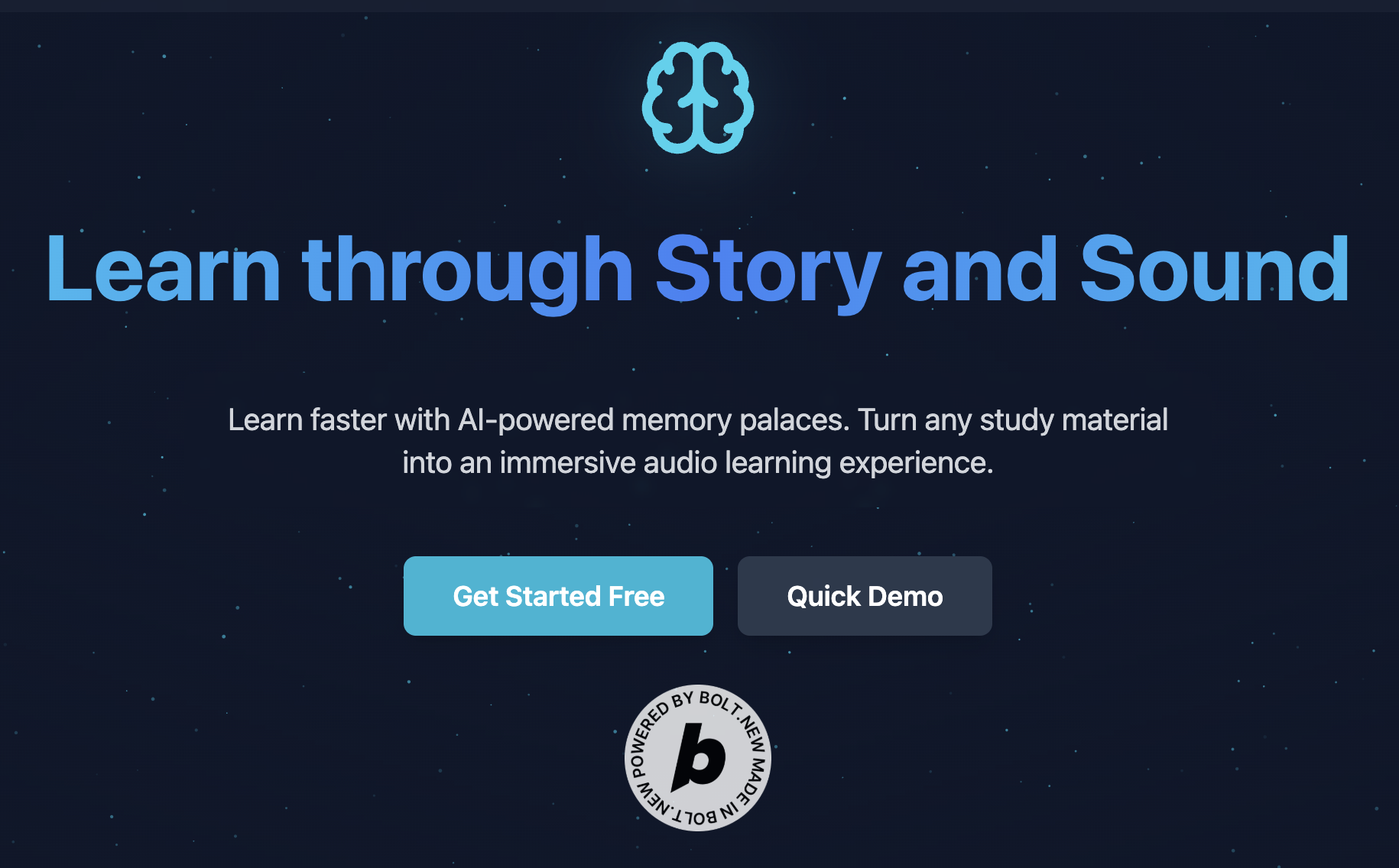
SpatiaLearn transforms any study material into immersive 3D memory palaces that students can walk through and explore. By combining ancient memory techniques with modern AI, it turns boring textbook content into memorable spatial experiences. Students don't just read about concepts—they literally walk through them in virtual spaces designed to make information stick.
Traditional studying relies heavily on repetitive reading and highlighting, which research shows has poor long-term retention rates. Students struggle to connect abstract concepts and often forget material shortly after exams. The ancient "memory palace" technique is proven effective but requires significant training and imagination that most students lack. There was no accessible way to automatically create these spatial learning experiences from regular study materials.
SpatiaLearn takes any text—from textbook chapters to lecture notes—and uses AI to generate a virtual memory palace where each concept becomes a room or landmark. Students navigate through these 3D spaces while AI-generated narration explains connections between ideas. For example, a biology chapter on photosynthesis becomes a journey through a virtual greenhouse where students encounter each step of the process as physical locations and interactive objects. The spatial relationships mirror the conceptual relationships, making complex topics intuitive and memorable.
Researched cognitive science behind spatial memory and learning retention
Designed AI prompting system to convert text into 3D spatial narratives
Built prototype using generative AI to create immersive learning environments
Integrated ElevenLabs for realistic audio narration and spatial sound design
Implemented fast iteration cycles, testing with students for immediate feedback
Developed unique "walk-through learning" interaction patterns
Beta students reported 60% better retention compared to traditional study methods
Discovered that AI can effectively translate abstract concepts into spatial metaphors
Learned the power of combining ancient learning techniques with modern technology
Developed expertise in educational AI applications and user experience for learning
Gained insights into the intersection of cognitive science and product design
Proved that immersive learning experiences can be generated, not just hand-crafted